

Marketing Attribution for Cannabis
Multi-Touch Models That Tell the Truth

Level: Intermediate
Videos: -
Length: 42min
Marketing Attribution for Cannabis Course
Marketing Attribution for Cannabis: Multi-Touch Models That Tell the Truth

Cannabis customer acquisition costs keep climbing, yet most cannabis marketers still grade their advertising on last-click attribution — a model that hands all the credit to the final tap before purchase and ignores everything that built the decision. The result is predictable: over-investment in bottom-funnel tactics, under-investment in the awareness that actually creates customers, and a ROAS number nobody can defend in a budget meeting.
This is the MediaJel attribution hub. It covers how marketing attribution works, which models fit the way cannabis consumers actually buy, the halo effect that last-click misses, and how to measure what your advertising truly caused. Where a topic deserves its own deep dive — cross-device identity resolution and incrementality testing — we summarize it here and point you to the full guide.
What You’ll Learn
- Why single-touch attribution quietly defunds your best campaigns
- The four multi-touch attribution models and when each one fits cannabis
- The halo effect: how upper-funnel channels lift conversions you credit elsewhere
- How to choose a model, set attribution windows, and track the right KPIs
- Where attribution ends and incrementality begins

The Attribution Crisis in Cannabis
Consider a real scenario. A potential customer sees your programmatic display ad, searches your dispensary on Google three days later, visits your website, receives a geofenced mobile ad near your store, and finally makes a purchase. Last-click attribution gives 100% of the credit to that final mobile ad and zero to the display ad that introduced your brand or the search that delivered product information.
Multiply that distortion across an entire budget and you are systematically defunding the campaigns that create demand while overfunding the ones that simply harvest it. In a market where acquisition costs rise every year and brand loyalty is thin, that’s not a reporting quirk — it’s a competitive disadvantage.
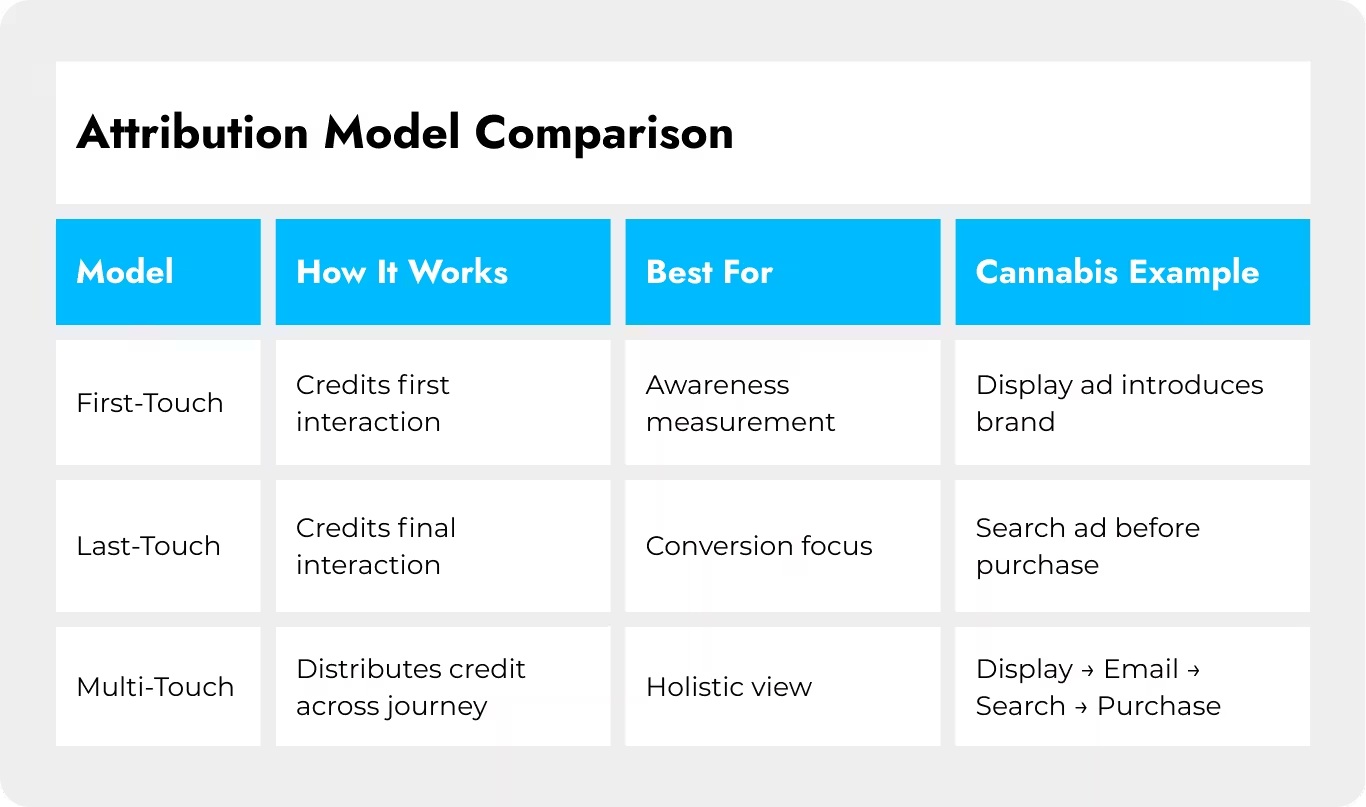
Single-Touch Attribution and Its Limits
First-touch attribution
Assigns all credit to the initial interaction. It tells you what drives awareness, but it ignores the nurturing required to convert — and cannabis buyers typically engage with several touchpoints before a first dispensary visit or online order.
Last-touch attribution
gives full credit to the final interaction. It severely undervalues everything upstream and creates a race to the bottom, where marketers overspend on branded search and retargeting while competitors quietly win the awareness game that feeds those channels in the first place.
Both share the same flaw: they pretend a multi-step journey was a single event.
Multi-Touch Attribution Models Explained
Multi-touch attribution (MTA) distributes credit across the journey instead of pinning it to one moment. The four models you’ll actually use.
Linear
Spreads credit evenly across every touchpoint. Democratic and simple, but it can overvalue low-impact touches like a single display impression.
Time-decay
Weights touchpoints closer to conversion more heavily. A mobile ad an hour before a dispensary visit earns more than a display ad two weeks prior — which fits the recency-driven way cannabis purchases often happen.
Position-based (U-shaped)
Gives 40% each to the first and last touch and splits the remaining 20% across the middle. It honors both the channel that created awareness and the one that closed.
Data-driven
Uses machine learning to assign credit by statistical impact across real conversion paths. The most accurate, but it needs volume — generally 1,000+ monthly conversions to be reliable.
Why Multi-Touch Attribution Matters for Cannabis
Cannabis purchase journeys are genuinely complex — research, consideration, and compliance gating all play a role before a sale. Multi-touch attribution matters because.
Customers move across display, search, social, and in-store before buying.
Display exposure measurably lifts search conversion rates (more below).
Not on which channel happened to be last.
The Halo Effect: Why Your Channels Lift Each Other

The single biggest thing last-click misses is the halo effect — the indirect lift that one channel creates for others. Upper-funnel exposure doesn’t just build awareness in the abstract; it measurably improves the performance of the channels that get the credit.
The clearest example in cannabis: consumers are roughly 20% more likely to convert on paid search when display is running alongside it.
The display ad rarely gets the click, so last-click logs it as a failure — while it’s quietly inflating the branded-search and direct-traffic numbers you’re praising. Think of a billboard on your daily commute. You don’t pull off the freeway the moment you see it, but when you finally search the dispensary, that sign is why. That’s the halo effect, and it’s exactly the value last-click erases.
Naming the halo effect matters because it sets up the harder measurement question: if a channel lifts others without earning clicks, how do you prove it’s working at all? That’s where incrementality comes in.
Choosing the Right Attribution Model
Your ideal model depends on a few factors:
Newer operators benefit from first-touch to learn what drives awareness.
Brand-building campaigns suit position-based models.
Data-driven attribution needs 1,000+ monthly conversions.
Longer consideration windows favor time-decay.
Most sophisticated cannabis operators run several models in parallel and compare — a practice called attribution triangulation that prevents over-reliance on any single model’s bias.
Attribution KPIs to Track
Primary metrics
Impressions (reach), clicks, click-through rate (CTR), conversions (sign-ups and transactions), and ROAS (typical target range 3:1 to 8:1).
Advanced metrics
View-through conversions (post-view attribution), cost per acquisition (CPA), customer lifetime value (LTV), and attribution rate (the share of sales attributed to marketing).
Setting Up Tracking
Install the MediaJel pixel across all pages.
Configure conversion events (sign-ups, transactions).
Set your attribution window. The MediaJel platform offers a 1-to-30-day toggle; a 10-day window is a sensible default for most cannabis advertisers.
A note on scope: running display in isolation is rarely enough. Omni-channel programs that combine display, search, email, and social create the compounding effect that makes attribution worth measuring in the first place. See our guide to omnichannel vs. multichannel marketing.
Cross-Device Identity Resolution (Summary + Full Guide)

Cannabis consumers move across desktop, tablet, mobile, and in-store before they buy — and with third-party cookies disappearing, connecting those touches is harder than ever. Brands relying on last-click or siloed analytics miss a large share of the influence display, search, and loyalty campaigns have across the journey. Closing those gaps requires both deterministic matching (verified signals like loyalty logins, email captures, and SMS opt-ins) and probabilistic matching (behavioral and contextual signals like household IP clustering and cross-device session patterns), stitched together in a privacy-safe identity graph built for regulated industries.
🚀Read the full breakdown: Cannabis Identity Resolution and the Customer Journey.
Incrementality: Measuring What You Actually Caused (Summary + Full Guide)

Attribution tells you which touches got credit. Incrementality answers the harder, more honest question: would this sale have happened anyway? Because of the halo effect, attribution alone can’t fully prove causation — a channel can be undervalued (display) or overvalued (branded search capturing demand other channels created).
Exposed-vs-control cohort testing is the gold standard, and geo-experiments are how cannabis advertisers run it: hold out comparable markets, run campaigns only in test markets, and measure the lift. In one multi-state example, programmatic display tested across matched Colorado DMAs produced a measurable incremental revenue lift over control markets — proof of impact beyond correlation.
🚀Read the full methodology: What Incremental Lift Actually Means.
Validating and Optimizing Your Attribution
Attribution models are hypotheses about behavior — worth testing and acting on, not setting once and forgetting:
Does 7 days capture most conversions, or do your buyers need 14–30? Compare windows to balance accuracy with actionability.
If your model credits display with 30%, run campaigns with and without display to confirm the modeled impact matches reality (this is incrementality in practice).
Feed attribution insight back into bids, creative sequencing, and audience building — increasing investment in undervalued upper-funnel channels and pausing what multi-touch analysis shows isn’t contributing.
For a deeper comparison of measurement approaches, see media mix modeling vs. attribution and our roundup of multi-touch attribution tools.
Common Objection

“We want to see last-click engagement from our display ads.”
We get the instinct to tie spend directly to last-click conversions — but that’s not how cannabis consumers behave in a considered-purchase category. Display ads can carry bottom-funnel messages (discounts, retargeting), but they primarily work at the top and middle of the funnel: building awareness, shaping consideration, and warming audiences. Most buyers see a display ad multiple times, then arrive via search, email, or direct — and convert there.
That’s the halo effect again: studies show consumers are about 20% more likely to click and convert on paid search when display runs alongside it. Measure only last-click and you’ll undervalue the channel doing the priming.

What we recommend instead: pair realistic display benchmarks with multi-touch attribution, lifetime-value segmentation, branded-search lift, and audience growth. Track view-through conversions, monitor branded-search and direct-traffic increases, use retargeting performance to capture downstream display influence, and add attention metrics (scroll depth, time on site) to gauge quality. Display is your awareness engine — combined with strong SEO, landing pages, and retargeting, it becomes a core growth driver, not a last-click underperformer.
Put It to Work

Multi-touch attribution, identity resolution, and incrementality measurement aren’t separate tools — they’re one connected view of what your marketing actually causes. That view is built into DataJel, MediaJel’s retail analytics and attribution platform for cannabis operators, purpose-built for regulated industries so you stay compliant while you measure.
Stop making six-figure budget decisions on incomplete, last-click data. For a practical walkthrough of tying revenue to channels, see our guide to marketing revenue attribution, or talk to a MediaJel strategist.
Key Takeaways
- Last-click attribution systematically defunds the upper-funnel channels that create demand.
- Multi-touch models (linear, time-decay, position-based, data-driven) distribute credit across the real journey — run several in parallel and compare.
- The halo effect is the value last-click misses; display lifts paid-search conversions by roughly 20%.
- Attribution shows which touches got credit; incrementality proves what your marketing actually caused.
- For software, dashboards, and platform capabilities, that’s DataJel’s job — this hub is where you learn the fundamentals.
The strategies and insights shared in this course are based on MediaJel’s extensive experience in cannabis marketing and programmatic advertising. Results may vary based on individual implementation, market conditions, and compliance requirements.
Resources
Browse through our collection of helpful resources designed to support your learning. You'll find useful links, materials, and tools to explore at your own pace. These resources are here to enhance your experience and keep you moving forward.
Blogs
Services
expand & engage retain & grow
From a dispensary launching in a local market to an established brand seeking to expand worldwide, programmatic can fuel your growth.
MediaJel is the industry’s digital marketing platform of choice for grow-focused brands and retailers like you.
Ready to accelerate?