As cannabis brands navigate platform restrictions on Instagram and Facebook, Bluesky is emerging as a social channel worth paying attention to — with fewer gatekeepers and an audience that rewards authentic, community-driven content. This podcast features social media strategist Amy Donahue to discuss whether Bluesky is the next meaningful channel for cannabis brand growth.The conversation explores Bluesky's platform dynamics, how cannabis brands can establish a presence there, and what's required to build real awareness and community on an emerging network. Cannabis social media managers, brand marketers, and any operator looking to expand their organic social footprint beyond Meta's restrictions will find this a timely and practical discussion.

The lessons, mistakes, and growth strategies behind the industry’s most recognizable brands.
Is Bluesky the Next Big Social Channel for Cannabis Brands?

Watch Our FREE OnDemand Webinars

Key Insights
- BlueSky is emerging as a meaningful social media platform for national cannabis brands because it hosts an active community of cannabis enthusiasts who can discuss and share cannabis content without the platform restrictions that limit organic reach on Meta and X - and with an open, chronological feed rather than an engagement-manipulation algorithm, authentic content performs on its own merits rather than through paid amplification.
- The decision to use BlueSky for a cannabis brand depends on scale: national cannabis brands and products with broad geographic reach have an active engaged community already on the platform and are missing a real opportunity by not being there, while local dispensaries may find that the current user base does not yet overlap meaningfully with their local customer geography.
- BlueSky's domain-as-handle feature lets cannabis brands use their actual website domain as their social handle, which functions as a built-in credibility signal - consumers can verify that the account belongs to the brand without depending on a platform-managed verification system, which matters for an industry where trust and legitimacy are active concerns.
- Marketing and advertising are distinct activities within the same discipline: advertising promotes specific offers, deals, and products to drive immediate action, while social media marketing is about building brand awareness through storytelling - sharing who the brand is, what it stands for, and what it cares about - and conflating the two leads to social content that feels transactional rather than community-building.
- Buying followers or engagement is one of the most counterproductive things a cannabis brand can do on social media: it inflates vanity metrics while destroying the authentic community relationships that make social presence actually valuable, and on platforms like BlueSky where organic reach is the point, a purchased audience produces zero real business value.
Put these Insights into Action
Whether you're optimizing product mix, improving customer retention, or measuring market performance. Mediajel helps cannabis operators turn data into profitable growth.
Marketing Attribution
See exactly which campaigns generate dispensary revenue - not just clicks.
Programmatic Advertising
Reach the right customers with data-driven targeting that maximizes ROI.
Cannabis SEO
Capture more high-intent shoppers and increase organic visibility.
Podcast Highlights
00:00 – Why Cannabis Brands Need Social Media Alternatives
The podcast opens with the reality that cannabis brands face on major social platforms: Meta actively restricts cannabis advertising and organic reach, and X (formerly Twitter) has become increasingly difficult since its 2022 ownership change brought algorithm shifts, fake account proliferation, and unreliable verification. With those platforms constrained, cannabis marketers need alternatives - and BlueSky is the one generating the most relevant traction for the cannabis community right now.
06:00 – What BlueSky Is and How It Works
Jared Mursky, who joined BlueSky during its invite-only period and has been active on the platform for over 18 months, explains what makes it different: a chronological feed that shows posts without algorithm-driven amplification, open-source infrastructure, and a community culture that prioritizes authentic engagement over viral performance metrics. The platform functions the way Twitter did in its early years - where good content found its audience through genuine sharing rather than paid promotion.
12:00 – Domain Names as Social Handles
One of BlueSky's distinctive features discussed in the podcast is the ability to use a custom domain name as your social handle - making it possible for a cannabis brand to present as, for example, @theirdomain.com rather than a platform-generated username. This feature provides a built-in verification signal: the platform checks the domain, and a matching handle tells followers the account is legitimately connected to the brand's actual website - a particularly meaningful credibility layer in cannabis, where account legitimacy is not always assumed.
18:00 – Who Should Be on BlueSky Now
The conversation gets specific about which cannabis brands have the most to gain from BlueSky right now. National cannabis brands and products with broad consumer audiences will find an active, enthusiastic community already discussing cannabis freely on the platform - and not being there is a missed opportunity. Local dispensaries, on the other hand, may find that the current BlueSky user base is not yet concentrated enough in their specific geographic market to generate meaningful foot traffic or local customer relationships.
24:00 – Building Community vs. Buying Followers
Jared is direct about the wrong approach to social media growth: buying followers or engagement destroys the authentic community relationships that make social presence actually valuable. On a platform like BlueSky where organic reach is the core value proposition, a purchased audience produces no real business return. The right approach is building community through consistent, genuine content - telling the brand's story, sharing what it stands for, and participating in the conversations already happening among cannabis enthusiasts on the platform.
30:00 – Marketing vs. Advertising: Understanding the Distinction
The closing segment addresses a conceptual clarity that cannabis marketers often lack: marketing and advertising are related but distinct activities. Advertising promotes specific products, deals, or offers to drive immediate action. Social media marketing - particularly on a platform like BlueSky - is about brand storytelling: sharing who the brand is, what it cares about, and why it exists. Brands that approach every social post as an advertisement produce content that feels transactional. Brands that approach social media as a storytelling channel build the community relationships that eventually make advertising more effective.
Frequently Asked Questions
[ {What is BlueSky and why does it matter for cannabis brands?}
BlueSky is a social media platform with a chronological, algorithm-free feed and open-source infrastructure that has developed an active community of cannabis enthusiasts who can discuss and share cannabis content without the advertising restrictions and organic reach limitations that cannabis brands face on Meta and X. Unlike those platforms, BlueSky was not built around advertising revenue and does not suppress content types that major advertisers find objectionable - which makes it a more permissive environment for cannabis brand content and community building.
{Should cannabis brands join BlueSky?}
National cannabis brands and products with broad consumer audiences should actively be on BlueSky - the platform already hosts an engaged community of cannabis enthusiasts, and not being there is a missed first-mover opportunity. Local dispensaries may find the current user base is not yet concentrated in their specific geographic market, making the platform a lower priority than local SEO, email, or community-specific digital channels. As the platform grows, the calculus may shift for local operators.
{How does BlueSky's domain handle feature work for cannabis brands?}
BlueSky allows users to set their account handle to a domain name they own - for example, a cannabis brand could use @theirdomain.com as their social handle. The platform verifies that the domain is connected to the account, which functions as a built-in credential check: followers can confirm the account is legitimately connected to the brand's actual website. This is particularly valuable for cannabis brands, where platform account legitimacy is not always assumed and trust is a prerequisite for community engagement.
{What is the difference between cannabis social media marketing and cannabis advertising?}
Cannabis advertising promotes specific products, deals, and offers to drive immediate purchase behavior. Cannabis social media marketing is a broader practice focused on brand storytelling - communicating who the brand is, what it stands for, and what it cares about through content that builds community relationships over time. Social media marketing does not primarily ask for a transaction. Advertising does. Both are necessary, but conflating them leads to social content that feels transactional and erodes the community trust that makes social media presence valuable in the first place.
{Why should cannabis brands avoid buying followers?}
Buying followers on social media inflates vanity metrics - follower count, like counts - while destroying the authentic community relationships that give social presence its actual business value. On platforms like BlueSky where the value proposition is organic, algorithm-free community engagement, a purchased audience produces no real reach or engagement because those followers are not genuinely interested in the brand. Brands that buy followers signal to their real audience that they are optimizing for appearances rather than building genuine relationships, which erodes exactly the trust that cannabis brands most need to establish. ]
Cannabis Podcast Full Transcript
{}
Introduction
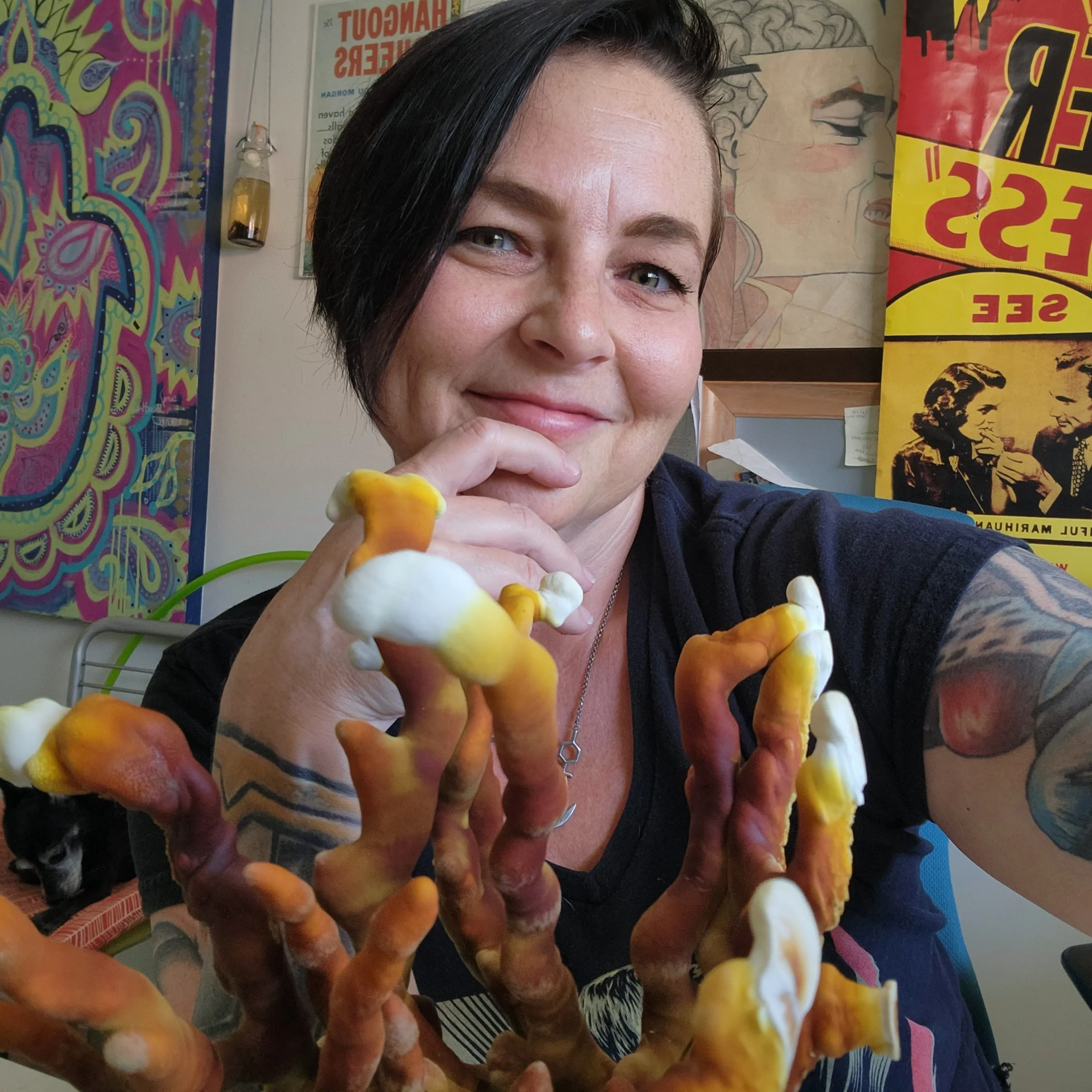
Jake Litke: Welcome everyone to another episode of Cannabis Marketing Live. I am your host, Jake Litke, CEO of MediaJel, and today we have Amy. Amy helps startups and companies with their social media strategy, awareness, and getting their presence out on the interwebs. Amy, welcome, thank you for taking the time today. Please introduce yourself, tell us a little about why you're here today, and then we'll get into it.
From MySpace to Cannabis Marketing
Amy: Hi, I'm Amy. I started doing social media on MySpace — I was a stand-up comedian and radio DJ here in Phoenix for many years, and I used MySpace to create my community and get followers for my gigs and radio show. Then a little air conditioning repair company in Chandler, Arizona, asked me to help them put their company on MySpace, and I was like, "why do you want your company on social media, that's the stupidest thing I've ever heard" — and here we are. I started with car dealerships, done pretty much every industry. Then, in 2011, I donated my kidney because of a tweet, and got my medical marijuana card soon after, because my recipient's kidney failure was from Motrin, and I wanted a safe way to deal with everything we all deal with. In 2012, 2013, I got my first cannabis client, learned a lot about trademarking and business stuff in cannabis that most of us just don't know — but you learn by doing. I was one of the first members of local Women Grow, had the first cannabis marketing agency here in Arizona, Hybrid Social, and now it's just me, a consultant and advisor helping people be compliant and professional on social media. I've spoken at MJBizCon a couple times, Imperious, Southwest Cannabis Conference, and every podcast that happened during the pandemic.
Jake Litke: Fair enough, yes, there were plenty of those. Well, let's get into what we're talking about, social media in general — you've been doing it since MySpace, about as far back as it goes, unless you want to talk about Friendster.
Amy: On the same day — I was a high school Spanish teacher at the time, and my kids were like, "you got to be on here," I logged into Friendster once, never logged in again, and stayed on MySpace, because Tom Anderson was your first friend.
Jake Litke: There you go. So you've been working in cannabis a long time, I have as well, there's a lot of issues there, right, because, first of all, it's technically just not allowed, especially for large, publicly traded US companies. Today, everyone probably already knows it's difficult to do anything on Meta, X is a little easier these days, but we're here to talk about Bluesky, which I know a little about — I have an account, haven't used it much, tried Mastodon for a minute, that was just confusing. Maybe we could start with a state of the union on Bluesky as you see it today, what does it look like?
State of the Union: What Is Bluesky Today?
Amy: I've been on every network as well, Mastodon was confusing for me too, but as a social media manager I go on everything. I joined Bluesky when it was still invite-only, been on there about 18 months, because Twitter was always my favorite, I was on there since 2008. Unfortunately, in 2022, when Elon Musk bought it, the algorithm changed, a lot of fake accounts came in, and when the verification process changed, it got really hard to get into that algorithm — I was hanging on by a thread, like that loose tooth waiting to pop out, and I ended up deleting it about two months ago. But thankfully I've developed a great network on Bluesky. One thing I'll mention — it's International Women's Month, and Bluesky is owned by a woman, the CEO is Jay Graber, and the COO is also a woman, so I think it's appropriate we're talking about this this month. I've always been pro-female in this industry, we need a stronger voice to build our network. It's microblogging, just like Twitter — a certain number of characters to get your thoughts out, provide a link, go from there. They have feeds too, which we'll get to — I'm going to pause and let you go, because I could go on and on.
Jake Litke: We'll see if we can keep it focused, I tend to go off on tangents too, maybe we're a bad combo. So, you're defining Bluesky as a microblogging platform — I know Twitter/X changed to allow long-form posts — is Bluesky still, what's the character limit?
Amy: Oh my gosh, good question, I don't even remember — I think it's 200 or 250, I just went through this yesterday with a client's account. It's smaller, but in this day and age you kind of have to smack people in the face with the information you want to give them, not give them a book — that's what your blog and website are for.
How Bluesky Has Grown
Jake Litke: You were on Bluesky back when it was invite-only — how have you seen it grow from then to now? Has it been a straight line, or lumpy?
Amy: I was one of the first million users, and once this past election happened, I think people were waiting to see what was going to happen, and that caused the bump in users — they went from maybe 3 million last summer to now up to 33 million, gaining a new user every second. It's not as big as the others, but right now is the perfect time to be on there, because I'm building connections — I've made wonderful connections with other women in cannabis I've never seen on LinkedIn or any other network. That's what social media is about, it's not for selling your product, that's what marketing is for, this is for building a network. Once things really blew up this past November, it got a little dicey for a while — there's a thing called starter packs, which we'll get into, that got pretty obnoxious, I don't like spammy practices, quick user growth, I don't think it's genuine. But it's a great place to get news — Wired's been on there forever, so there are really great national names already utilizing Bluesky.
What Are Starter Packs?
Jake Litke: Let's dive into starter packs before I forget — what is a starter pack, and what does it do?
Amy: I have a cannabis industry starter pack on my profile — it's literally a list of people, for whatever the starter pack's about, that you can follow all at once, to start creating that community. As soon as somebody follows me, I vet them, I don't follow back everybody, to make sure they're a legit, legal cannabis account, not some online plug from Telegram. You can see starter packs on user profiles, and it's a little different from lists — lists are just a list of users, but don't give you the ability to follow everyone at once.
Jake Litke: So it's like a bulk follow?
Amy: It is, but you don't have to follow them all at once, you can just follow, follow — I'm not following everybody all at once from a starter pack, but it gives people who don't know what I do an easy way in, and people follow back, because the people there want to create big communities.
Jake Litke: Have you found more real people versus bots on Bluesky?
Amy: Oh yeah, if there's a bot it gets called out immediately, reported, taken down within minutes — people will screenshot, share it, "here's the history of the bot activity," gone. Their moderation is amazing.
Jake Litke: Are starter packs all user-generated, or some from Bluesky itself?
Amy: No, they're user-generated.
Evaluating Who to Follow
Jake Litke: For someone like me, not super familiar — I click on a cannabis industry starter pack, see a list, probably makes sense to spend time deciding who to follow. What guidance would you give — let's not use your starter pack since you know it well, say there's a jazz musician starter pack — what tips for deciding who to follow?
Amy: I don't pay attention to number of followers, I don't think that's important on social media. I'll look at a profile, same as LinkedIn when I get a connection request, I don't just connect, I check if it's relevant. If they joined a year ago and haven't posted since, I'm less likely to follow — a lot of people start accounts and never go back. I make sure their feed isn't all reposts — it's actually called a "skeet," as in sky and tweet together, but generally called "posts" — I want to see their own content, what they have to say, whether they've logged in since creating the account. Some get thousands of followers and never log in again, which is kind of sad. I also check if they're being professional — if it's a jazz musician list, I don't want to see inappropriate content.
Jake Litke: Fair enough, that's usually a good filter — kind of common sense and intuitive, similar to when we look at a brand's blog and check when the last post was — if it's a year and a half ago, that indicates a marketing presence they're not maintaining, doesn't necessarily mean the product is bad, but it's an indication. Same logic applies to a Bluesky profile — are they active, posting original content, or just reposting others?
Amy: Right, and that's called "parroting" — nobody wants a parrot, if you're just repeating what others say, you have no personality of your own.
Custom Feeds and Open-Source Features
Jake Litke: All right, so that's starter packs — what other core concepts do people need to understand within the Bluesky ecosystem?
Amy: One thing I really like is it has open code, so people can personalize and create cool feeds — for example, a feed I followed from the beginning was cooking, because I love to cook. They created a feed so that every time someone posts a food pic with the plate, fork, and knife emoji, it automatically shows up in that feed. Lots of personalization if you're nerdy like that — I follow nerds like that, there's weather feeds too. Having the ability to create stuff, and not just be fed everything — if you look at Instagram, it's just stories in a feed, boring, and now shopping too.
Jake Litke: Don't forget all the shopping now.
Amy: I don't feed into that algorithm myself, I will never buy anything off Instagram, if you follow me on LinkedIn you know why. But yeah, it's open source — one cool thing, you can have your handle be your domain name, Wired was the first I'd seen do that, and I did it for a client, you have to put some code on your website, it checks, a lot of technical wording I don't fully understand, but the women who work there do — now their handle is their website, pretty cool, no more "link in bio."
Hashtags: Search Tool, Not Decoration
Jake Litke: So you can use hashtags too?
Amy: Yes, if you're searching for feeds to follow, you go to the hashtag icon on the left menu on your home screen — those are feeds. Unfortunately, I think people don't really understand what hashtags are for, they think it's an accessory, when it's for search — that's why hashtags like #420 aren't clickable on Instagram, because it's shadowbanned, and that's what a hashtag is for, to click and see who else is talking about that subject. They've used the pound sign for feeds, hashtags are allowed and searchable there. Best practice, only use a couple hashtags, as an indexing or search function, not made-up hashtags for whatever you're doing.
Jake Litke: That was fun back in the day on Twitter, hashtag-I'm-not-getting-off-the-couch, those were fun.
Amy: We just don't do that anymore, I'll sometimes do it for fun, but hashtags are for search, they're not earrings you put on before going out to dinner — be mindful and strategic, is this hashtag relevant to my post, why do I have 30 on here when I'm not even tracking them.
Tracking Hashtag Performance
Jake Litke: Let's talk about tracking hashtags — say I'm a cannabis dispensary doing an in-store activation event, I put #420 so people find it — what does tracking hashtags mean exactly?
Amy: When you do what I do, there are apps you can use to track hashtags to see how content is performing for clients.
Jake Litke: Any recommendations for tools?
Amy: There are tons, I use several, depends, always playing around with what's new and what's free, because cannabis, nobody really has budget for extras — it's another application I have to pay for, but it's super simple.
Jake Litke: What insights have you gleaned from tracking hashtag usage?
Amy: When I was going through my kidney donation process, every Monday I'd have "kidney chat" on Twitter — hashtags were also for chats, there was "digiblogchat" every Tuesday, run by a girlfriend of mine. I did kidney chat every Monday and could see how many more accounts were using it, retweeting, how many times the hashtag was used during my chat.
Cannabis Culture on Bluesky
Jake Litke: Now let's talk about cannabis, probably one of the reasons people are here — what's the environment like for cannabis on Bluesky?
Amy: When I first got on there, I was so happy, everybody was talking about smoking pot — I'm 54, been smoking since 1987, so I finally felt like I found my people, talking about it the way we used to on Twitter, getting through the algorithm without having to hide. There are several communities — a 420 community, psychedelics are also popular — people can openly post photos, talk about going to the dispensary, their new bong, and not get shadowbanned. But I need to state, I don't think the industry really understands that social media is not about selling your product, that's what marketing's for — social media is called "social," pause for emphasis, "media" for a reason, not "buy my media." Go on there and be social, interact by looking for feeds and searching hashtags like #420.
Advertising (or the Lack of It) on Bluesky
Jake Litke: Let's talk advertising, since most social networks are funded by ad dollars — what does the advertising environment look like on Bluesky right now, are you seeing ads today?
Amy: No, there are no ads. The difference is there's paid media, which is ads, and social media, which is creating community. No ads yet on Bluesky, and I like that, I don't need that ad in my feed, I want to see people being social and growing a community. For right now, you have to go on there and be social.
Jake Litke: So how does Bluesky make money, do you know?
Amy: They have investors. At some point they'll have to make money, but right now they're selling t-shirts — Jay Graber wore a "back at you" t-shirt at South by Southwest, a response to Zuckerberg's t-shirt, and those sold out, so maybe they're a t-shirt company now. I'm sure there'll be ads at some point, but I feel this could really work out as a community movement. Save your ad dollars for email and SMS marketing, because social media is social, it's not always about advertising — in cannabis, people feel like, "what can I throw money at now," throw money at hiring a real social media manager to get your brand out there and interacting with potential customers.
Jake Litke: While there's no sponsored posts, do you see organic posts about sales or promotions happening today?
Amy: Not really with dispensaries yet, I don't think they think outside of Instagram, honestly, no offense — but you can't have all your stuff on one network. Maybe it'll open up, but this is social media — I see people posting about Etsy, Patreon, "here's my cooking channel," things like that, driving traffic to places to make money, rather than just throwing money at a social network. You need someone spending time there, or you'll fail.
Jake Litke: We have a question from Erica — a lot of social networks started off friendly toward cannabis and then devolved away from that, have you seen anything Bluesky's publicly stated about its stance on cannabis?
Amy: No — in their terms of service, all it says is no dealing in illegal goods, and considering we're still federally illegal, I wouldn't take that chance. But again, this isn't for selling your products, all of your social media should be about showcasing the people behind the brand — who's your grower, who's your bud tender of the month, telling the brand's story. I feel this industry still doesn't even know how to use Instagram properly, that's why they get shut down. Tell a story, it's social media, not "buy my media," build communities. A local dispensary might not get much traction there now, but if you're a national brand and not on there, you're missing out on a lot of enthusiasts who can freely talk about cannabis, so why not be there?
Marketing vs. Advertising: Where Bluesky Fits in the Funnel
Jake Litke: Let's talk about the distinction between marketing and advertising — advertising's a discipline within marketing, the overall concept of getting brand awareness to consumers, and social media marketing is a subset, with nuanced ways to do it — telling your brand story, explaining who you are, versus advertising a specific deal to get someone to buy at a specific moment. Most cannabis companies have limited marketing channels open to them — we actually allow cannabis companies to do display advertising across most mediums now, websites and apps. Getting back to social — when people approach a platform, the first thing they often try is, "how do I sell more products," and go straight to paid, "I want to advertise my offer." How do you navigate that conversation, helping people delineate between social media as an awareness and engagement platform, versus a selling channel?
Amy: Just like every industry, your social media should drive traffic to your website, that's where the magic happens, where people sign up for your email list or SMS texting, get to your own platform. There's a difference — here's my take on cannabis, not trying to offend anybody, we've been here for new ideas, new products, innovation forever, but if you don't understand marketing and social media, none of it's going to work. I suggest educating yourself on the differences, you can make or break a brand with one bad post, your account gets shut down. Facebook and Twitter were never the same, neither are SMS and email marketing. Social media is a portion of advertising and marketing, but it's not the money part, it's the social part — building community, finding influencers who'll speak about your product, sometimes for free product, sometimes you pay them, but there are creative ways beyond just throwing money at an ad. If you're not being social on your account but paying for an ad, why? If you think you can get friends by throwing money at them, are they real friends, will they come back if you're not interacting?
Jake Litke: To put this in the context of advertising, which is primarily what we do — paid media across channels — when approaching a marketing strategy, you generally have a funnel: awareness, engagement, conversion. You'd think of Bluesky as really the very top of the funnel, awareness, a little engagement, but the engagement should transition into going to your owned website, where you have the conversion conversation — here's my products, here's my offer, here's why you should buy. Does that make sense?
Amy: Yep, we're done, Jake, see you later — thank you for the opportunity. That's exactly it, that sales funnel, I don't think a lot of new entrepreneurs understand all that, there's a lot that goes into building a company, but yeah, that's exactly what the social media part of your marketing strategy should be.
Jake Litke: There's a little cognitive retraining that needs to happen, because most brands think of social media as an advertising channel, and direct response specifically — a specific term where the expectation is you serve an ad, someone sees it, clicks it, buys something, usually low-cost goods that look shiny — but when building a real brand, you have to think about brand equity and a lot else. It's set up like a real social network, about brand building and engagement, keeping that conversation authentic to the domain, then giving people the opportunity to come talk to you about products outside the network — like a networking event, "hey, I'm Amy," "hey, I'm Jake, what do you do," "I'm at MediaJel," "what do you do, Amy," "where'd you have lunch today," "what grade are your kids in" — that's what social media is supposed to be, getting to know people, building relationships, and then building loyalty for your brand or dispensary through that.
Jake Litke: We have another question from an anonymous attendee about starter packs with a low number of likes — is that indicative of the community, or a warning sign?
Amy: You still want to investigate the accounts in that starter pack, that's what counts. Some I wouldn't follow back because they're not super active, that's a turnoff for me. It's not about the likes, it's about engagement — are the posts getting engagement, likes, reposts, comments? Those matter more to me than follower count.
Likes, Engagement, and What Actually Matters
Jake Litke: That brings up another question about likes in general — what's the range where you'd think, "wow, this has a lot of traction"?
Amy: It depends on the size of your account. For me, dozens of likes is fine, but it's more important to have comments and replies, because I can go down and just like everything — does that mean I actually read it, went to that person's account? Engagement is more than likes, it's reposts, but replies, to me, are way more important, and for my clients too.
Why Engagement Farming Doesn't Belong on Bluesky
Jake Litke: Let's talk about managing a Bluesky account — on Instagram, there have been companies that run "engagement farms," where you hire people to go find profiles in a category and post comments, like a bunch of other comments — a sloppy, brute-force approach, but it works relatively well on Instagram, for better or worse.
Amy: It can get you shut down too, it's actually against the terms of service, which nobody reads. Farming is very disingenuous — I look at this industry as something genuine and transparent, and if you have to pay people to like your stuff, I don't want to be your friend, that's not genuine or transparent. All those likes might get you into the algorithm until you get shut down, but will it convert to anything? Fake likes aren't going to your website. Buying followers is like the bully in middle school who had to buy peanut butter fudge for everybody to like him — I don't believe in paying for any of that, I think it's all bad practice.
Jake Litke: I agree, though my opinions aren't shared by everybody — my question's more about the current reality of Bluesky, and whether you see that happening. A lot of Instagram's revenue is related to direct-response product selling, so, from a purely capitalist perspective, invest X dollars in getting likes, bring the post up, more people see it, more likely to purchase — this is a different kind of domain.
Amy: You just said the perfect word, organic. If you can't be organic in your social media, don't be on that platform. If you can't hire somebody to spend time building your brand there, don't be there. There's nothing worse than buying people to like your stuff, that makes me sick inside.
A Blueprint for New Brands on Bluesky
Jake Litke: Now that we've talked about what not to do, let's talk about how you'd onboard a brand new to Bluesky — what's the blueprint for starting off on the right foot?
Amy: Start following people, they don't always have to be 100% relevant. Follow, check their posts, like, repost, reply — you can repost with your own thoughts, which I like most, that's what I do on LinkedIn too, just reposting doesn't carry as much weight in the algorithm. I have a client brand new on Bluesky, less than a month — they're in the travel part of the cannabis industry, so I follow travel stuff, not necessarily 420 accounts, because it's about travel, destinations. Follow normal people too — it's a huge platform for politics, senators are realizing the value of being there. A dispensary isn't just weed, it's the products and people behind them, so think outside the cannabis box. For me, it's cooking, weather — Saturday is huge on Bluesky, post a picture of your cat, you'll get followers just from that, there are feeds of hundreds of cat posts. Find stuff that gives you personality, because if you have no personality, no one wants to be your friend, and they're certainly not going to your dispensary.
Jake Litke: Cats still rule the internet, always will.
Jake Litke: We have a question from Clint — how do cannabis brands impact conversation at scale to start getting traction on brand equity, what's important to measure, and how long before ROI matters? Let's take those one at a time — is there a cadence for following and commenting on posts?
Amy: I believe every network deserves an hour of work a day for a brand — break it into a couple 15-minute chunks, maybe better traction in the afternoon, look at your analytics to know when to post. It's a new network, takes work to figure out what performs when, you need a presence, it's not just post and go — otherwise it'd be called "post-and-go media." Find stuff you're interested in — if the brand is a sun-grown grow in California with a greenhouse, get into greenhouse conversations with hothouse tomato people, gardening is gardening. It's International Women's Month, have you followed and amplified more women's messaging? If 4/20's coming up, comment, "oh my god, what strain is that," it's not hard. Fifteen-minute chunks, maybe twice a day, but if you're just going to post and not interact, don't be there — you'll look like a tool bag and won't get as many followers. I get followers when I comment on a feed, three or four within a minute, because we're all looking for like-minded friends. When you comment, look who else commented, follow them back, doesn't always have to be cannabis, because if you only talk about weed at a party, that's boring.
Measuring ROI and Brand Equity
Jake Litke: The second part of Clint's question — what's important to measure, and how long before ROI? Marketing managers need to justify time spent, an hour a day adds up on a P&L — how does a marketer arm themselves for that conversation with a business owner who might not care about social media at all?
Amy: I do feel every marketer should be on there to practice and see how it works, but you can check web traffic, Google Analytics, to see where traffic is coming from, that's how you test ROI. Will you get some on Bluesky starting an account today? Probably not within a week or two, you need to build it up, people need to like what they see. What's the ROI of your mom — that's a Gary Vee quote, first person I ever followed on social media, he said there's not always going to be an ROI. What's the ROI of Coca-Cola? When brands are that well known, it's harder to track. Not everything drives a sale, some of it's about branding, and branding isn't just your logo, it's who your company is, you can't always measure that.
Jake Litke: Brand equity is something I believe in a lot, though, up until now, it's been perceived by most cannabis operators as a luxury, because marketing dollars get taxed or don't get written off, so they're 30% more expensive than they should be, and existing in cannabis is difficult, so people don't invest in brand equity, even though it's the only path to long-term success — most are more tactical, in survival mode right now. But something you said is a good answer — you spend time on Bluesky, get traction, and you'll see in your referrals what percentage of website traffic is coming from Bluesky, starting at zero, maybe going to 1, 2, 3%. As a marketer, you could make a compelling argument, taking the whole of your online sales and saying Bluesky's contributing a percentage equal to the traffic it's generating — you could go further with UTM codes, but that's a place to start, generating interest from a more authentic set of users, with fewer bots. And you could measure engagement rate for users from that channel — got 100,000 people to your site, but if time on site was five seconds, that's not good, so break your channels apart, look at engagement rate.
Amy: [audio cuts briefly] The most important takeaway is that social media is a marathon, not a sprint. If you create an account today expecting 10 sales tomorrow, it won't work, and it could be detrimental to your brand. When you talk about brand equity, that whole picture comes together — I truly believe in it, especially if you're national. If you're a person, you definitely need to be on there — I've worked from Chattahoochee to San Diego, being a voice for social media and cannabis is important, but it takes a while. I have about 2,500 followers, took me 18 months to get there, and I'm totally fine with that, because that's 2,500 people who want to hear what I have to say — if it were a hundred, I'd still be happy, that's a hundred people interested in what I have to say, that's what social media's about, community, engaging, and believing in what you're putting out there.
Avoiding Common Mistakes
Jake Litke: That makes sense, we're coming up close to time, if anyone has other questions get them in now. I wanted to do a couple quick summaries — what are your top tips of things to avoid, mistakes you've seen people make?
Amy: I'd say — I call them "vacant profiles," created a year ago, never came back. I'm probably not going to follow that account, because I know they're not spending time there. Overuse of reposting — if all you're doing is parroting, why would I want to go to a party with you if all you do is repeat what everybody else says around you? Envision Bluesky like a professional networking group, that's the best way to understand it. Following too many accounts at once — if you follow 500 accounts, did you actually vet them, or are you just worried about the numbers? Maybe Bluesky isn't for you if that's your only concern.
Jake Litke: I want it to be for everybody — it's still small, 33 million people, but your target audience is probably there, especially in cannabis. Let's circle back — has anyone gotten their hand slapped on Bluesky for talking about cannabis?
Amy: Not cannabis — they're very anti-hate-speech, that's the one thing I've seen people get shut down for. I haven't seen anybody posting, "here's my second account, because I got banned," but I'll say right now, please don't do that. Treat it as a new network that's growing, you can be part of that foundation, or ruin it for everybody, which is usually what happens to most things once there's enough people.
Jake Litke: What are some questions I haven't asked that you wanted to cover?
Amy: Just the no-advertising thing — I've met a couple great women there, one has a podcast about edibles called Bite Me, and I met a New York publicist, Type A Tracy, meeting people in this industry I've never met before, despite a huge LinkedIn community, because I've spent time there. The biggest age bracket on Bluesky is Gen Z, and that's the fastest-growing demographic in cannabis right now — these kids grew up in a weird time, went through a pandemic, probably learned more about cannabis then. Your target audience is most likely there, but if you're very localized, not an MSO, you might not get the conversion you're looking for — you have to know your target audience isn't everybody over 21 who smokes pot, and you need to be paying attention to Gen Z, they terrify me, I love them, but I've got one turning 22 in my house, my niece, I ask her for advice all the time.
Jake Litke: I've gotten to the age where I ask my teenage daughter to translate things for me too. For the user experience, what's the media mix, text, image, video, any trends happening?
Amy: It really does mirror Twitter five years ago — they just opened up video within the past two or three months, instead of just linking to your TikTok, you can post the video there. I'm a political junkie, not afraid to admit it, so a lot of my stuff is text-only, but our society needs to be punched in the face with a video. You'll see a great mix, mostly text, I'd say 70% text, 30% divided between photos and video, except Saturday. Videos are smaller in number but gaining traction, since that's how you get into algorithms on other networks, and I'm glad they finally opened up to that.
Predictions for Bluesky's Future
Jake Litke: All right, we're just about up on time — what are your predictions for Bluesky over the next year or so?
Amy: I feel it could easily be 100 million users by this time next year, somebody write that down, come back to me, if I was wrong I'll take it. I think it's going to continue growing, I hope it continues getting people away from Meta — I don't think we should be supporting Meta at all, because of the damage they've done to small businesses in this industry, and we keep going back. I see it multiplying month over month, gaining at least a million users — what other network is growing that fast? People are leaving Meta networks to find something nicer, why not support that? They're creating new features all the time, you can't send media through a DM yet, that will change, no group DMs yet, that will change. Keep in mind this network is technically from 2019, but really only opened up two years ago. If you're there, you're part of something growing, with a great feel, free to be — a huge LGBTQ community, I just logged on and thought, "oh my gosh, it just feels nicer too." I think that continues, and it's not a tech oligarch behind it, that should attract people too.
Closing Remarks
Jake Litke: Well, I'll dust off my Bluesky account, you've convinced me I should start — I'll DM you, add you to my starter pack, all the things. Speaking of contacting you — how do people listening today get a hold of you, if they want help, to ask questions, or see pictures of your cat?
Amy: I'd say definitely follow me on Bluesky, I'm "the fabulous one," one word, all spelled out, that's what I've always been. Amy on LinkedIn, I've got 16,000 connections, been on LinkedIn 21 years, that is my website, I've created a great environment for myself, or email me at amy@hybridsocial.com, I offer a free 15-minute consultation, to preach the gospel or just look at stuff. For me it's about building a network, being able to refer clients to you as well, I'm a networker, I want everybody to work with good people.
Jake Litke: Awesome, well, thank you again for your time and your wisdom.
Amy: For the opportunity, I'm honored — MediaJel, I've been a fan forever.
Jake Litke: Oh good, so we have at least one fan, that's good, I like that. Amy on LinkedIn, or "the fabulous one" — is it O-N-E?
Amy: Yep, all letters spelled out, on Bluesky.
Jake Litke: Okay, great, I'll send you a connection request on Bluesky, and we can continue the conversation there.
Amy: Awesome, thank you so much, Jake.
Jake Litke: Thanks, Amy.
Featured Speakers
Related Cannabis Podcasts
Compliance Doesn't Pause for M&A: How to Protect Your Cannabis License Through a Merger or Acquisition
What Your Deep Discounts Are Saying About Your Cannabis Business

Unrolling Cannabis Education with Saif Khan, Rachelle Gordon and Ryan Porter
Webinar Highlights


Other Ways to Enjoy the Cannabis Podcast
.jpg)