

Cannabis Tech Stack GuideHow to Build, Optimize, and Scale the Technology Behind Modern Cannabis Retail
The cannabis industry is one of the most heavily regulated retail categories, and because of that, dispensaries depend on a highly specialized set of cannabis tech tools to operate legally, efficiently, and profitably.
Start Course
Level: Intermediate
Videos: 1
Length: 12min
This course walks you through every major component of the modern cannabis tech stack, including POS systems, dispensary software, CRM solutions, menu integrations, payment technology, analytics platforms, and marketing tools designed specifically for regulated markets. Whether you're launching a new dispensary, upgrading your operational systems, or planning a multi-store expansion, this course provides the blueprint for building a connected, compliant, and scalable cannabis tech stack that supports long-term retail success.
Streamline Your Operations: How Your Cannabis Techstack Transforms Your Business
A connected cannabis techstack streamlines your entire dispensary, automating compliance, syncing inventory, improving customer experience, and reducing operational friction. When your POS, CRM, menu tools, and marketing systems work together, your business becomes more efficient, more profitable, and easier to scale.
What is a Cannabis Tech stack?
Your cannabis tech stack refers to the collection of software systems and integrations you utilize to operate your dispensary. It typically includes:
- Cannabis POS – transactions, inventory, compliance
- Compliance Tools – integrations with METRC, BioTrack, or other state systems
- Cannabis CRM & Loyalty – customer data, segmentation, and rewards
- Online Menu & eCommerce – real-time product menus, pickup, and delivery ordering
- Payments & Hardware – card processing, cash drawers, scanners, label printers, tablets
- Marketing & Attribution Platforms – Plan, launch, optimize and attribute campaigns with tools like MediaJel, Alpine IQ, SpringBig
- Analytics & Reporting – dashboards and reports for performance, LTV, and ROI
When these tools are integrated—rather than siloed—you get:
- A single source of truth for inventory and sales
- Better compliance and fewer manual tasks
- More effective and targeted marketing
- A consistent customer experience across in-store and online channels
Your cannabis POS sits at the center of this techstack, feeding data to and from every other system.
What Is a Cannabis POS System?
A cannabis POS (point of sale) system is the backbone of any successful dispensary. Unlike generic retail POS platforms, cannabis POS software is purpose-built for the industry, offering features like:
- Seed-to-sale tracking
- Compliance with state regulations
- Integrations with METRC or BioTrack
- Built-in purchase limits and age verification
- Detailed reporting and audit trails
These systems enable dispensaries to:
- Manage transactions
- Track inventory and product movement
- Verify age and eligibility
- Generate compliance and performance reports all in one place
With cannabis laws varying by state, having a compliant and flexible POS solution is critical for ensuring your business stays within legal boundaries while providing a seamless checkout experience for your customers.
What Is Dispensary Software?
Dispensary software is the set of digital tools cannabis retailers use to run daily operations—like ringing up sales, tracking inventory, managing patient/customer data, and staying compliant with state reporting rules (ex: METRC).
Most dispensaries start with a cannabis POS system (point-of-sale), but “dispensary software” often includes more than just the register.
Why Your Dispensary Needs Cannabis-Specific Software
Using software built specifically for the cannabis industry is no longer optional; it’s essential. Cannabis-specific POS systems integrate features designed to solve for:
- Regulatory compliance with automated reporting tools
- ID and age verification to ensure 21+ or medical-only audience targeting
- Seed-to-sale tracking to monitor inventory and prevent diversion
- Real-time menu and inventory syncing with your eCommerce platforms
Generic POS tools simply can’t handle the complexity and regulation that come with operating a licensed cannabis business. A cannabis-specific techstack keeps you compliant, efficient, and ready to scale.
Key Features of Dispensary Software & Cannabis POS
Explore the essential tools that drive modern cannabis retail performance, from inventory control to customer engagement and mobile checkout. Here’s what to look for in a high-performing cannabis POS system within your techstack:
Inventory Management
Maintain a compliant and accurate inventory across all locations. The right POS system provides:
- Real-time syncing with your in-store and online menu
- Automated low-stock alerts and reorder thresholds
- Batch, lot, and expiration date tracking
- Integrations with your state’s compliance system (e.g., METRC, BioTrack) for automated reporting and seed-to-sale visibility
Payment & Hardware Integration
Compliance-friendly payment options are a must. Make sure your POS supports:
- In-store card processing (if available in your market), such as PIN debit or ACH
- Hardware like barcode scanners, label printers, cash drawers, scales, and tablets
- Reliable, quick checkout flows that reduce friction for your customers
The right setup enables quick, compliant checkout and a smoother customer experience.
Sales Analytics & Reporting
Your POS should provide more than just transaction data. Look for customizable dashboards that track:
- Top-selling SKUs and categories
- Average order value (AOV) and units per transaction (UPT)
- Employee performance and budtender conversion
- Hourly and daily sales trends
- Promotion and discount performance
Advanced reporting enables dispensaries to identify sales opportunities and operational bottlenecks while ensuring accountability and transparency.
Marketing & CRM Integration
POS software should seamlessly connect with marketing tools like MediaJel, Alpine IQ, SpringBig. This enables you to:
- Sync audience and purchase data into your CRM and marketing platforms
- Automate re-engagement campaigns based on visit recency or spend
- Trigger offers based on customer behavior (e.g., favorite products, spend tiers)
- Turn raw transaction data into real-time, personalized marketing
This is where your cannabis techstack becomes a revenue engine, not just a cost center.
Mobile & Tablet Functionality
Mobility is crucial, particularly for curbside delivery, high-traffic retail operations, and other similar scenarios. Tablet-friendly POS platforms allow staff to:
- Complete orders on the floor
- Manage lines more efficiently
- Handle pre-orders and express checkouts
- Stay productive even when lines are long
Ensure your POS works across devices and supports offline mode in case of connectivity issues.
Benefits of Using Dispensary Software as Part of Your Techstack
Implementing modern dispensary software and cannabis POS within an integrated cannabis techstack delivers:
- Increased Efficiency
Automate daily operations and reduce manual errors across compliance, inventory, and reporting. - Enhanced Customer Experience
Deliver fast, personalized service across in-store and digital touchpoints. - Better Data Management
Make smarter decisions with real-time reporting, consolidated dashboards, and accurate analytics. - Scalability
Add locations, product lines, or services without rebuilding your systems from scratch.
How to Choose the Best Cannabis POS System for Your Dispensary
When selecting a POS platform as the core of your cannabis techstack, consider:
- Your dispensary type (single location vs. MSO, medical vs. adult-use)
- State(s) you operate in and compliance requirements
- Hardware compatibility (scanners, printers, tablets, cash drawers)
- Ease of training for your team and onboarding support
- Quality and hours of customer service and technical support
- Integrations with CRM, menu, delivery, marketing, and accounting platforms
- Flexibility to adapt as regulations, markets, and your business evolve
Not all cannabis POS systems are created equal. Look for providers who understand your compliance needs and offer built-in flexibility to support your growth.
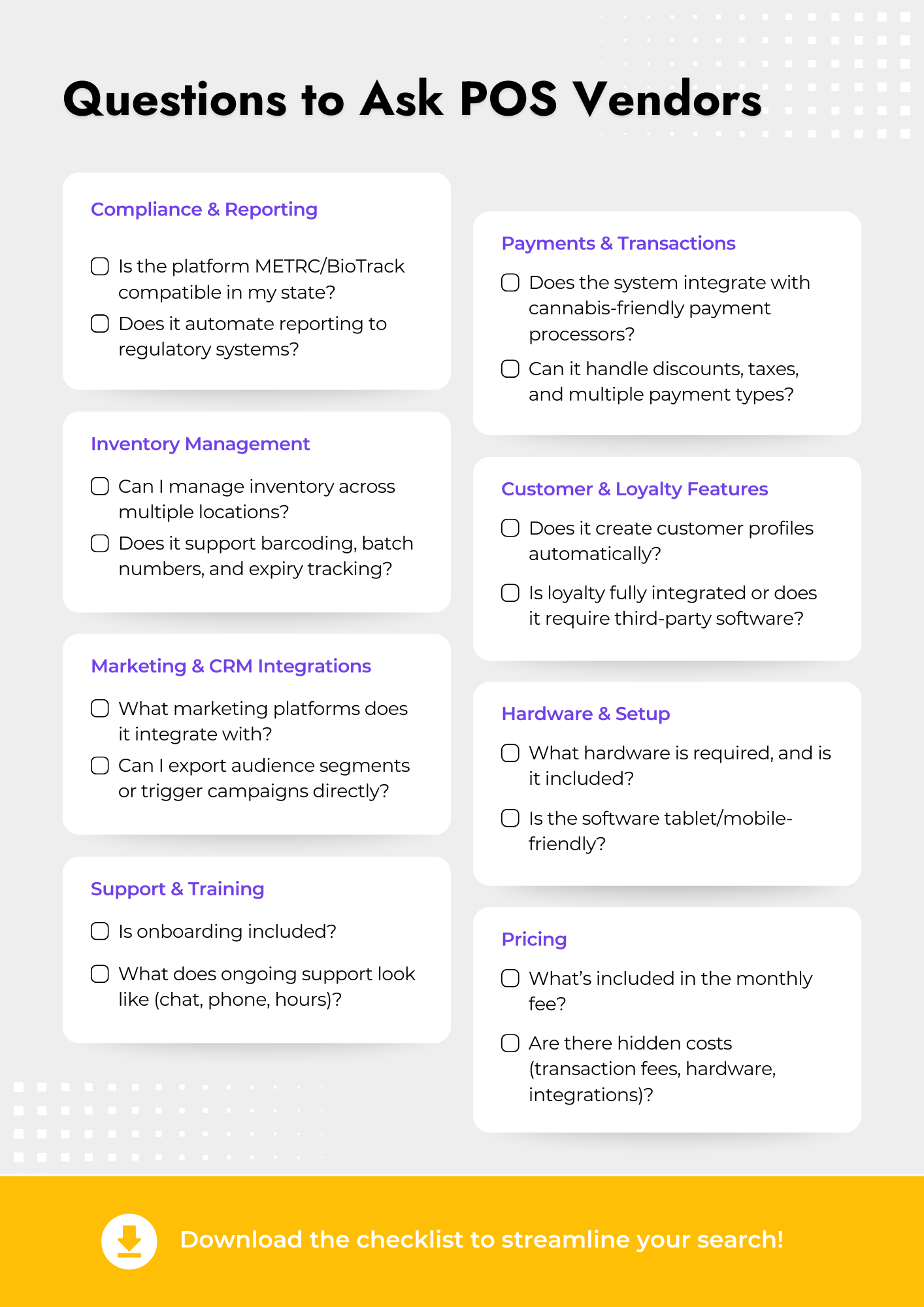
Demo Checklist: Questions to Ask POS Vendors
Who are the Leading Cannabis Software Companies and Technology Providers
The cannabis tech landscape is evolving quickly. Some of the top cannabis software companies offering robust POS systems and supporting tools include:
- Dutchie – Known for all-in-one POS, eCommerce, and compliance
- Flowhub – Offers mobile check-in, inventory tools, and integrations
- COVA – Focuses on compliance, intuitive UX, and quick setup
- Blaze – Strong delivery, inventory, and MSO support
- Treez – Built for scaling operations, analytics-heavy
- MediaJel – Not a POS; use it for marketing attribution, compliant advertising, and first-party data activation
These platforms support key integrations, provide robust support, and continue to evolve as regulations and customer expectations change. A cannabis marketing agency can help identify and connect the right mix of these tools through your tech stack, giving you a powerful foundation to grow on.
How POS Software Powers the Cannabis Techstack
Your POS is the core of your cannabis tech stack. It connects:
- Sales – every transaction routes through your POS
- Compliance – each sale and adjustment is reported to your state system
- Inventory – stock levels are updated in real-time
- Customer Data – purchases flow into your CRM and loyalty tools
- Marketing – transaction data feeds into platforms like MediaJel for attribution and audience building
With a fully integrated cannabis techstack, you can:
- Activate data-driven marketing campaigns
- Track customer lifetime value and segment by behavior
- Run compliant, geo-targeted ad campaigns
- Align in-store and online experiences with synced menus and inventory
- Gain the visibility and control needed to scale with confidence
Customer Relationship Management (CRM): Why It Matters More in Cannabis
Modern dispensaries rely on more than just a POS—they need a CRM (Customer Relationship Management) system to manage customer data, personalize engagement, and drive loyalty. But unlike traditional retail CRMs, cannabis-specific platforms must support:
- Regulatory compliance and opt-in controls
- Age-gating and geo-gating
- Seed-to-sale and POS integrations
- Restrictions on messaging content and channels
A cannabis CRM helps you:
- Build customer profiles for segmentation and loyalty campaigns
- Launch automated cannabis SMS and email promotions
- Sync with your POS, online menu, and inventory systems
- Track marketing ROAS and customer lifetime value
- Stay compliant with age-gating and data laws
Popular cannabis CRM tools include Alpine IQ, SpringBig, and Happy Cabbage—many of which integrate directly with leading POS systems like Flowhub, COVA, and Treez.
💡 Pro Tip: Opt for a CRM specifically designed for the cannabis industry, rather than a generic retail system. You’ll avoid compliance gaps and get faster time-to-value.
Key Benefits of a CRM Solution for Cannabis Dispensaries
A CRM isn’t just a tech tool; it’s a growth engine. With the right cannabis CRM, you can:
- Build Direct Customer Relationships
Stay connected with your customers through personalized, one-to-one communication. - Increase Loyalty and Repeat Business
Turn first-time buyers into loyal, long-term customers with targeted outreach and rewards. - Enhance Marketing Performance
Unify campaigns across channels and improve marketing effectiveness with data-driven insights. - Boost Sales with Personalized Offers
Deliver timely promotions, loyalty incentives, and special offers based on customer behavior. - Streamline Operations and Ensure Compliance
Simplify workflows while staying compliant with industry regulations and local laws. - Save Time Through Automation
Automate data collection, segmentation, and syncing with online menus and ordering systems. - Track ROI with Real-Time Visibility
Know what’s working by measuring campaign performance, sales lift, and customer retention. - Leverage Analytics to Drive Strategy
Understand customer habits and preferences to shape more effective promotions and experiences.
What Questions Should You Ask When Evaluating a Cannabis CRM Provider?
Choosing the wrong CRM can cost more than just money; it can slow down growth and introduce risk. Use the questions below to guide your evaluation process:
- Is your CRM purpose-built for cannabis?
- If not, how have you adapted it to meet industry-specific compliance and operational needs?
- How long have you been serving cannabis dispensaries, and can you share any relevant case studies or experiences?
- What is your pricing structure (monthly, annually, per store, per user)?
- Are there setup, onboarding, or integration costs?
- What’s the total cost of ownership over 12–36 months?
- Who are your integration partners (POS, online ordering, loyalty, inventory, marketing)?
- Is the platform scalable—can it grow as we add locations or expand services?
- Which third-party developers or agencies do you work with or recommend? Are they cannabis-compliant and experienced?
- What training and support do you provide? Is training included? Is it ongoing or one-time? Is support available during business hours only, or is it available beyond that?
Bringing It All Together: Your Cannabis Techstack as a Strategic Advantage
Choosing the right dispensary software is a strategic investment in compliance, efficiency, and growth. From inventory to cannabis marketing to loyalty, your cannabis POS and CRM systems form the backbone of your cannabis techstack and, by extension, your retail operation.
As the industry evolves, so should your tech stack. Evaluate your tools regularly, prioritize seamless integrations, and don’t settle for generic systems that weren’t built for cannabis.
Need help aligning your software stack with your growth goals? Contact our team to discover how MediaJel helps dispensaries transform data into revenue.
FAQs About Cannabis POS, Dispensary Software & Your Techstack
No. Cannabis POS systems offer mandatory seed-to-sale reporting, age verification, and state compliance features that traditional POS tools cannot provide. Operating without one puts your license at risk.
A cannabis POS handles transactions, compliance, and real-time inventory movement. Dispensary software is a broader category that includes POS plus order fulfillment, menu sync, CRM, analytics, delivery workflows, and other operational tools.
A modern techstack includes:
- Cannabis POS
- Compliance (METRC/BioTrack)
- CRM & loyalty
- Online menus/eCommerce
- Payment solutions
- Marketing & data platforms
- Analytics & reporting dashboards
- When integrated, these tools create a single, scalable ecosystem.
Yes. Cannabis POS must handle state compliance, purchase limits, THC equivalency calculations, ID verification, controlled inventory tracking, and seed-to-sale reporting.
Choose a POS that integrates seamlessly with your CRM, menu, payment system, and marketing tools. Compliance integration (METRC/BioTrack) should be automatic, not manual.
Most cannabis POS systems charge per location per month. Additional fees may include onboarding, support tiers, API access, hardware, and integration add-ons.
Absolutely. Without integration, you can’t activate first-party customer data, personalize offers, automate loyalty, or track marketing ROI—weakening your entire tech stack.
CRM connects customer behavior, preferences, and purchase activity to your marketing tools. It powers segmentation, loyalty, retention, and personalized experiences.
Menus sync inventory from your POS in real time, ensuring accurate availability for pickup or delivery. They also connect to loyalty systems, promos, and eCommerce tools.
Using disconnected tools. When POS, CRM, menus, payments, and marketing platforms don’t talk to each other, you create compliance gaps, duplicated data, and lost revenue opportunities.
Yes—if your POS and CRM support multi-location management. Look for centralized product catalogs, enterprise permissions, and consolidated reporting.
Marketing tools like MediaJel utilize POS and CRM data to execute compliant targeting, build targeted audiences, personalize offers, and attribute revenue to specific campaigns. Without integrated data, marketing performance is limited.
The strategies and insights shared in this course are based on MediaJel’s extensive experience in cannabis marketing and programmatic advertising. Results may vary based on individual implementation, market conditions, and compliance requirements.
Videos
Welcome to our Academy video series, where learning is simple, engaging, and accessible. Each video is crafted to help you grow your skills, gain new insights, and stay inspired. No matter your background or goals, there’s something here for everyone.
Webinar
Resources
Browse through our collection of helpful resources designed to support your learning. You'll find useful links, materials, and tools to explore at your own pace. These resources are here to enhance your experience and keep you moving forward.
Blogs
Services
expand & engage retain & grow
From a dispensary launching in a local market to an established brand seeking to expand worldwide, programmatic can fuel your growth.
MediaJel is the industry’s digital marketing platform of choice for grow-focused brands and retailers like you.
Ready to accelerate?