

Marketing Attribution
Multi-Touch Models for Cannabis Success

Level: Intermediate
Videos: -
Length: 42min
In today's hyper-competitive cannabis market, where customer acquisition costs have risen 47% year-over-year, understanding exactly which touchpoints drive purchases isn't just important—it's survival. Yet 73% of cannabis marketers still rely on outdated last-click attribution, leaving millions in revenue on the table and misallocating precious marketing budgets.
This masterclass reveals the advanced attribution strategies that leading multi-state operators use. You'll discover why traditional attribution fails in cannabis, master multi-touch attribution models designed for our unique industry challenges, and learn how to implement incrementality testing that proves true marketing impact.
By the end of this course, you'll confidently build attribution models that account for privacy regulations, cross-device behavior, and offline conversions—turning your marketing dashboard into a strategic weapon that guides million-dollar decisions.
Attribution Model Fundamentals
Understanding how attribution works is essential for building effective marketing strategies. Many brands still rely on outdated, single-touch attribution models, either giving full credit to the first or last click. This approach oversimplifies the modern buyer journey, where consumers typically engage with multiple touch-points before making a purchase. From programmatic display ads to geofencing and search, each interaction plays a role. In this section, we’ll break down the fundamentals of attribution models, why they matter, and how they help marketers make smarter, data-driven decisions.
The Attribution Crisis in Cannabis Marketing
Cannabis marketers dramatically overvalue bottom-funnel tactics while underinvesting in the awareness and consideration campaigns that actually create customers.
Consider this real scenario: A potential customer sees your programmatic display ad, searches your dispensary on Google three days later, visits your website, receives a geofenced mobile ad near your store, and finally makes a purchase. Last-click attribution would give 100% credit to that final mobile ad, completely ignoring the display ad that introduced your brand and the search ad that provided crucial product information.
Understanding Single-Touch Attribution Limitations
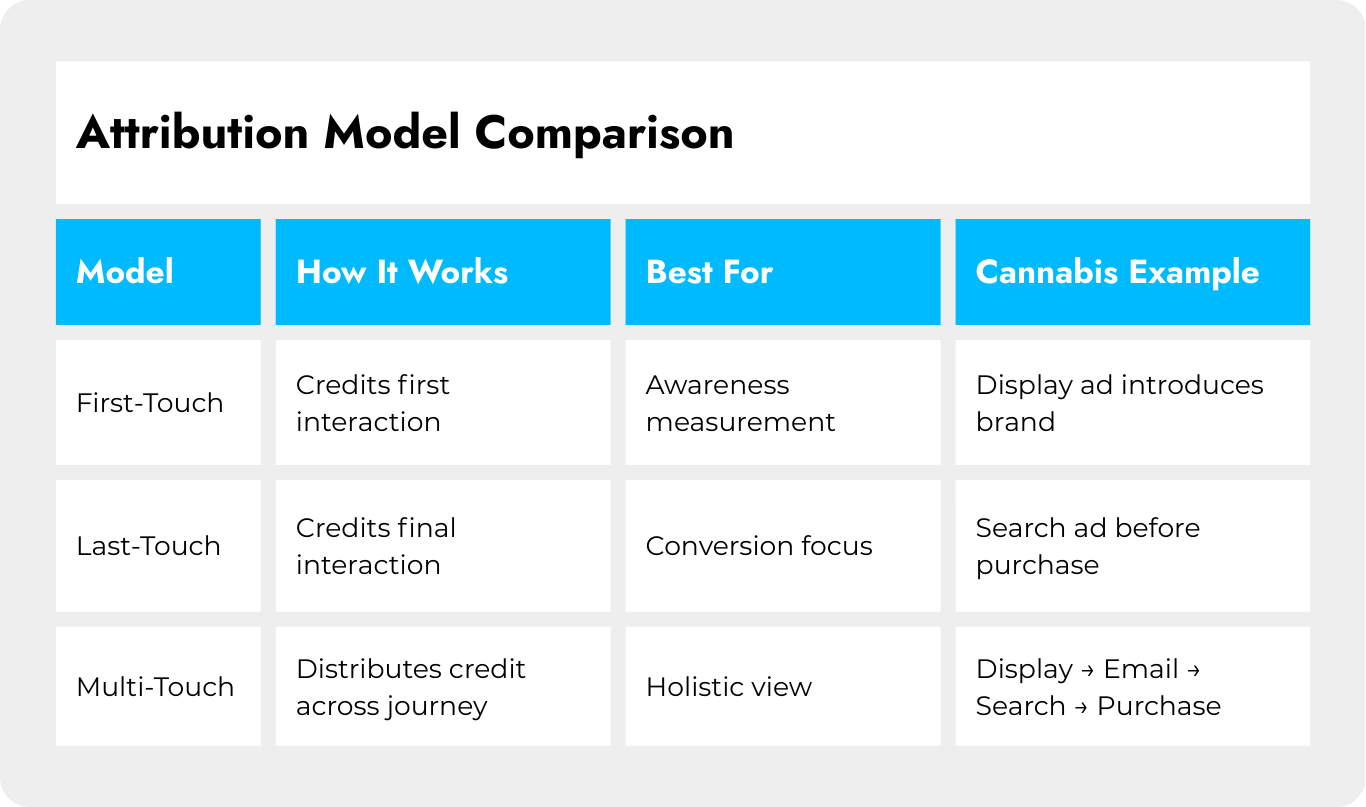
First-Touch Attribution assigns all conversion credit to the initial interaction. While this model helps understand which channels drive awareness, it completely ignores the nurturing required to convert cannabis consumers who average 7.3 touchpoints before their first dispensary visit or online purchase.
Last-Touch Attribution gives full credit to the final interaction before conversion. This model severely undervalues upper-funnel activities and creates a "race to the bottom" where marketers overspend on branded search and retargeting while competitors steal market share through awareness campaigns.
Attribution Model Comparison
Compare common attribution models to understand how each assigns credit across the customer journey—and choose the right fit for your campaign goals.
Multi-Touch Attribution Models Explained
Linear Attribution distributes credit equally across all touchpoints. If a customer interacts with five different marketing channels, each receives 20% credit. This democratic approach works well for understanding overall channel contribution, but may overvalue low-impact touchpoints like single display ad impressions.
Time-Decay Attribution assigns more credit to touchpoints closer to conversion. A mobile ad served one hour before a dispensary visit receives more credit than a display ad from two weeks prior. This model aligns well with cannabis purchase behavior, where recent interactions often have stronger influence.
Position-Based Attribution (also called U-Shaped) assigns 40% credit each to first and last touch, with remaining 20% distributed among middle interactions. This balanced approach recognizes both awareness creation and conversion driving, making it ideal for cannabis brands building long-term customer relationships.
Data-Driven Attribution uses machine learning to analyze actual conversion paths and assign credit based on statistical impact. This advanced model requires significant data volume but provides the most accurate view of true channel contribution.
Why Multi-Touch Attribution Matters
Multi-touch attribution (MTA) provides the most accurate picture of the customer journey. For cannabis businesses, this is crucial because:
- Complex Purchase Journey: Cannabis purchases involve research, consideration, and compliance
- Multiple Touchpoints: Customers interact across display, search, social, and in-store
- Channel Synergy: Display ads increase search conversion rates by 20%
- Budget Optimization: Understand true channel value for investment decisions
Key Performance Indicators (KPIs)
Primary Metrics:
- Impressions: Total ad displays (reach indicator)
- Clicks: Direct interactions with ads
- CTR: Click-through rate (benchmark: 0.2%)
- Conversions: Completed desired actions (sign ups, transactions)
- ROAS: Return on ad spend (target: 3:1 to 8:1)
Advanced Metrics:
- View-Through Conversions: Post-view attribution
- Cost Per Acquisition (CPA): Total cost per customer
- Lifetime Value (LTV): Long-term customer worth
- Attribution Rate: Percentage of sales attributed to marketing
Setting Up Tracking
Essential Implementation:
- Install MediaJel pixel on all pages
- Set up conversion events (sign-ups, transactions)
- Decide on attribution windows (MediaJel platform has a toggle for 1 day - 30 day attribution, 10 day window is recommended)
💡Pro Tip: Running display campaigns alone is insufficient. Omni-channel marketing that includes display, search, email, and social creates compounding effects and higher overall ROAS.
Choosing the Right Model for Your Cannabis Business
Your ideal attribution model depends on several factors:
- Business maturity: New businesses should emphasize first-touch to understand awareness drivers
- Marketing objectives: Brand-building campaigns benefit from position-based models
- Data volume: Data-driven attribution requires 1,000+ monthly conversions
- Sales cycle length: Longer consideration periods favor time-decay models
Most successful cannabis brands use multiple attribution models simultaneously, comparing results to gain comprehensive insights. This approach, called "attribution triangulation," prevents over-reliance on any single model's biases.
Learn more about marketing attribution models here.
Advanced Cross-Device Tracking & Identity Resolution for Regulated Industries
Today’s cannabis consumers don’t follow a linear path. They might discover your brand on a desktop at work, browse product options on a tablet at home, and check store hours or inventory on their phone before visiting. Without accurate cross-device tracking and identity resolution, these interactions appear disconnected—leaving gaps in your attribution, optimization, and campaign ROI.
Why Cross-Device Identity Matters
With third-party cookies disappearing and cannabis advertising regulations limiting data access, it’s harder than ever to track consumer behavior. Brands that rely solely on last-click metrics or siloed analytics are missing up to 80% of the influence display, search, and loyalty-based campaigns have across the buyer journey.
MediaJel’s Identity Resolution Framework
To solve this, MediaJel leverages a custom-built, privacy-safe identity graph that connects user behavior across devices, channels, and time—without relying solely on third-party cookies.
We combine:
1. Deterministic Matching
Uses verified data points to connect known user identities across environments:
- Loyalty program logins (web, app, and POS)
- Email address captures from forms or campaigns
- Phone number verification during compliance gating
- SMS opt-ins and in-store sign-ups
2. Probabilistic Matching
Uses behavioral and contextual signals to infer likely connections:
- IP address clustering within households or shared WiFi networks
- Time-based session patterns across multiple devices
- Similar product views and browsing behavior
- Location data suggesting coordinated device movement
3. MediaJel’s Custom Identity Graph
Our proprietary graph ingests both deterministic and probabilistic signals to create persistent, anonymized user profiles across sessions, campaigns, and devices. This enables:
- Multi-touch attribution (awareness to conversion)
- Smarter audience segmentation and retargeting
- More accurate ROAS reporting—even in cookie-less environments
- Seamless integration with CRM, loyalty, and in-store data for omnichannel tracking
✅ Key Advantage: Unlike generic ad platforms, MediaJel’s graph is purpose-built for regulated industries, ensuring compliance while maximizing reach and measurement accuracy.
💡Want to learn more about Identity Resolution? Read this: Cannabis Identity Resolution and The Customer Journey
Incrementality Testing & Lift Studies
Designing Geo-Experiments for Cannabis Campaigns
Incrementality testing answers the critical question: "Would this sale have happened without my marketing?" In cannabis, where brand loyalty remains low and consumers frequently switch dispensaries based on deals, understanding true incremental impact separates profitable marketing from expensive waste.
Geo-experiments provide the gold standard for incrementality measurement. By dividing similar markets into test and control groups, you can measure true campaign lift:
- Market selection: Choose comparable DMAs with similar demographics, competition, and regulations
- Baseline establishment: Measure natural sales patterns for 30-60 days pre-test
- Test execution: Run campaigns only in test markets while maintaining control markets
- Lift calculation: Compare test vs. control performance, accounting for external factors
A/B Testing for Attribution Validation
Attribution models are hypotheses about customer behavior—A/B testing proves whether they accurately predict real-world outcomes. Smart cannabis marketers regularly validate their attribution models through systematic testing:
Test different attribution windows: Does a 7-day window capture most conversions, or do cannabis consumers need 14-30 days? A/B test different windows to find optimal settings that balance accuracy with actionability.
Validate channel weights: If your model assigns 30% credit to display advertising, test campaigns with and without display to verify actual impact matches modeled attribution.
Challenge model assumptions: Position-based attribution assumes first and last touches matter most. Test this by running campaigns that emphasize middle-funnel tactics and measuring impact on overall conversions.
Real-Time Optimization Strategies
Static attribution models provide historical insights—real-time optimization transforms those insights into immediate revenue gains. The MediaJel Revenue Attribution Dashboard enables dynamic campaign optimization based on attribution data:
Automated bid adjustments respond to attribution insights:
- Increase bids on undervalued channels showing strong upper-funnel contribution
- Pause underperforming creative, inventory, and audiences based on multi-touch analysis
Creative optimization based on attribution paths:
- Serve awareness creative to users with no prior touchpoints
- Deploy consideration content after initial brand exposure
- Reserve promotional messages for bottom-funnel interactions
- Test creative sequences based on optimal attribution paths
Audience refinement using attribution intelligence:
- Identify high-value customer paths for lookalike modeling
- Build sequential audiences based on customer lifetime value segments and attribution stages
- Launch retargeting and retention focused campaigns
Key Takeaways
- Multi-touch attribution reveals hidden value in upper-funnel channels that last-click models ignore
- Incrementality testing provides insight into cannabis marketing impact beyond correlation
- Real-time optimization based on attribution insights helps drive performance improvements
- Custom attribution models aligned with business goals outperform one-size-fits-all approaches
- Continuous testing and validation ensure attribution accuracy as markets evolve
Common Objections
Objection: "We want to see last-click engagement from our display ads."
We understand the desire to tie ad spend directly to last-click conversions—but that's not how most consumers behave, especially in competitive or considered purchase categories like cannabis.
Here's the reality: Display ads can be used for bottom of funnel (discount messages and retargeting), but primarily play a top- and mid-funnel role, meaning they're designed to increase awareness, shape consideration, and warm up audiences—not necessarily to be the final click before a purchase. Most buyers don't see a display ad and immediately convert. Instead, they:
- See your display ad multiple times
- Visit your site organically or via search
- Click a branded search ad or email
- Then convert
In fact, studies show consumers are 20% more likely to click and convert on a paid search ad when display is running alongside it. That's the compounding effect of multichannel visibility. If you're only measuring last-click, you're undervaluing display's impact on the decision journey.
What We Recommend Instead: We set realistic performance benchmarks for display and pair them with multi-touch attribution, customer lifetime value segmentation, branded search performance, engagement lift, and audience growth to show how your programmatic ads are driving long-term results.
- Track view-through conversions, not just clicks
- Monitor branded search volume and direct traffic increases
- Use retargeting performance to capture display influence downstream
- Consider adding attention metrics (like scroll depth, time on site) to see display impact on user quality
Bottom line: Display is your awareness engine. It keeps your brand in the conversation. When combined with strong SEO, landing pages, and retargeting, it becomes a core driver of growth—not just a last-click performer.
Ready to Transform Your Cannabis Marketing Attribution?
Stop making million-dollar decisions based on incomplete data. The MediaJel Dashboard provides enterprise-grade attribution designed specifically for cannabis industry challenges.
The path forward is clear: implement multi-touch attribution, prove true marketing impact through incrementality testing, and optimize in real-time based on actual revenue data. Your competitors are already making these moves—can you afford to wait?
The strategies and insights shared in this course are based on MediaJel’s extensive experience in cannabis marketing and programmatic advertising. Results may vary based on individual implementation, market conditions, and compliance requirements.
Resources
Browse through our collection of helpful resources designed to support your learning. You'll find useful links, materials, and tools to explore at your own pace. These resources are here to enhance your experience and keep you moving forward.
Blogs
Services
expand & engage retain & grow
From a dispensary launching in a local market to an established brand seeking to expand worldwide, programmatic can fuel your growth.
MediaJel is the industry’s digital marketing platform of choice for grow-focused brands and retailers like you.
Ready to accelerate?