.svg)
.svg)

Choosing the Right White-label Programmatic Advertising Partner



Understanding White Labeling in Programmatic Advertising
Programmatic advertising is an automated, data-driven way to buy and place digital ads. For agencies serving cannabis and other regulated industries, white-label programmatic advertising platforms are the fastest, most compliant way to offer it; because purpose-built ad-tech handles the precise targeting, automation, and age-gating that mainstream platforms won't touch. The catch most agencies hit: they don't have the in-house technology or the trading expertise to run it well. That's the gap a white-label partner fills.
What Is White-Label Programmatic Advertising?
White-label programmatic advertising lets an agency resell another company's media buying, audience data, and reporting under its own brand. The partner runs the technology and the media; the agency keeps the client relationship, the dashboard branding, and the margin. In regulated industries like cannabis, it's the fastest compliant way to add a programmatic practice without building ad-tech in-house.
Why This Matters More in 2026
As of 2026, adult-use cannabis is legal in 24 states and Washington, D.C., and 41 states have legalized medical marijuana, yet Google, Meta, and most mainstream platforms still restrict cannabis ads. At the same time, privacy-first targeting is reshaping programmatic: third-party cookie signals now fragment across browsers and user-choice prompts, pushing performance toward first-party data and verified audiences. Both trends make a compliant, data-rich white-label partner more valuable, not less. Click here to check your state cannabis advertising laws.
Defining White Label Programmatic Advertising Partners
A white-label partner gives you access to a dashboard and features such as audience targeting, real-time bidding, and sophisticated analytics. "White label" means another company provides a ready-made, customizable solution you tailor and brand with your agency front and center, client reports and dashboard access run under your name.
White-label partners, such as MediaJel, develop and maintain the underlying technology, including demand-side platforms (DSPs), supply-side platforms (SSPs), and other tools necessary to meet ethical standards and stay compliant in programmatic advertising. You can use the platform, providing client reports and dashboard access underneath your own agency's brand to demonstrate how you are helping them excel. You use the platform; your clients see your brand.
Is MediaJel a DSP?
Not exactly, and the distinction matters. MediaJel is a managed trading desk, not a single DSP. Rather than locking campaigns into one platform's inventory, MediaJel buys compliant, curated supply through private deal IDs across multiple DSPs and premium SSP partnerships. For an agency, that means broader access and better auction economics than any one demand-side platform can offer.
Advantages of White-Labeled Programmatic Advertising
White-label programmatic advertising partners can be a valuable bridge between businesses and the complex world of cannabis programmatic advertising technology. Because white-label partners provide the technological backbone for programmatic advertising, you can access advanced features such as real-time bidding, precise targeting, and data analytics without investing in your own technology development and maintenance.
This means your agency can focus on scaling core competencies such as strategy, client relationships, and campaign management. Instead of spending agency resources finding audiences, you can give a good white label platform your parameters and they will find the audiences that fit your specifications and deliver compelling engagement in an easy-to-use platform.
Key Considerations for Choosing a White-Label Advertising Partner
As the expert in the advertising industry, clients trust you to vet your vendors and ensure a high-quality experience that delivers on the brand promises at scale. So, you must prioritize selecting the right white-label programmatic advertising partner and thoroughly assess key factors including expertise, transparency, technology, customer support, and scalability. You can build a strategic partnership from these foundational elements to empower both businesses to work toward mutually beneficial goals. Here are five essential qualities to find in a programmatic partner.
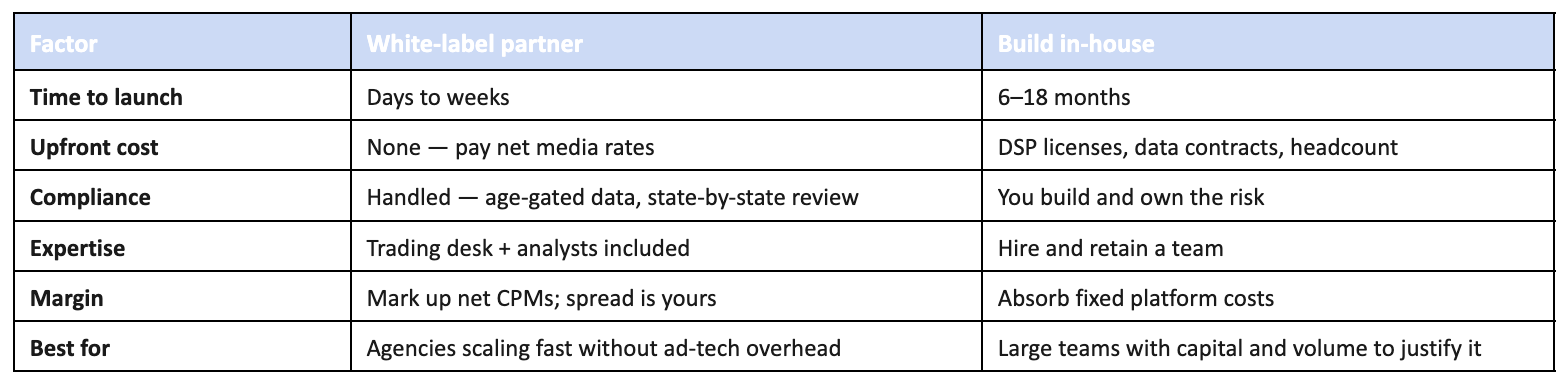
White-Label vs. Building In-House
For most agencies, the math is straightforward. Building a compliant programmatic capability in-house means licensing a DSP, signing data contracts, and hiring a trading team before a single campaign runs.
How to Choose a White-Label Programmatic Partner
Your clients trust you to vet vendors. Assess five factors, expertise, transparency, technology, support, and scalability, and ask the right questions of each.
Expertise and Industry Knowledge
True experts with industry knowledge in programmatic advertising will be able to provide concrete examples and case studies of successful campaigns. Look for the specific challenges they faced and the strategies they implemented based on emerging technology, industry trends, and best practices. If you have diverse clients, you will also need to assess their ability to offer tailored solutions based on the regulatory landscape of your clients. Start with questions like:
- How many years have you run programmatic for cannabis on your platform?
- Can you show successful campaigns for regulated industries like cannabis?
- How does the platform verify age gating?
- How have you incorporated emerging technologies into recent campaigns?
- What KPIs do you prioritize, and how is performance reported?
Data Transparency and Security
Your advertising partner's data transparency and security practices are integral to maintaining client trust and complying with privacy regulations. No matter how professional a partner may appear, you must protect your clients by inquiring about their data-handling processes. Cannabis is a highly regulated industry, and they should have high standards for their data sources.
Start by seeking clarity on data sourcing and origin. Ensure your potential partner can articulate the legitimacy of acquired data, their plans for adapting to evolving standards (such as GDPR (Europe), CIPA (California) and CCPA California), and protocols for security. A thorough examination of these areas will provide insight into a partner's commitment to data transparency, security, and privacy.
- Where do you source data for programmatic campaigns, and how do you verify its quality?
- Who owns the data collected during campaigns, and how do clients access and control it?
- How do you protect data in transmission and storage?
- Do you share customer data with third parties, and how do you vet them?
Technological Capabilities
Do a deep dive into the features of their programmatic advertising platform, real-time bidding, precise targeting, dynamic creative optimization, integrations, scalability, API access, and defenses against ad fraud
Understanding the platform's integrations with ad tech solutions and third-party tools provides insights into its adaptability and potential for enhancing campaign performance. Scalability, API accessibility, creative optimization tools, and robust measures against ad fraud further underscore the partner's technological capabilities. Ask:
- Can you show integrations that measurably improved campaign performance?
- How do you use AI and ML for optimization, targeting, and creative personalization?
- What tools support dynamic creative optimization?
- How does the platform detect and prevent ad fraud so budgets hit genuine impressions?
Customer Support and Communication
Effective customer support and communication are linchpins in a successful partnership with a white-label programmatic advertising provider. To evaluate their commitment to customer service, you must consider response time and the availability of diverse communication channels.
A responsive support team that promptly addresses client concerns and provides transparent updates during issue resolution can significantly impact campaign performance, and your client’s satisfaction. Choosing a white-label programmatic partner with a strong focus on customer support and communication sets the foundation for a collaborative, efficient, and successful long-term relationship. Ask them:
- How fast is your support response, and is there a contact for urgent issues?
- What channels and working hours do you offer, including after-hours support?
- How do you support onboarding and training?
- Do clients get a knowledge base or self-serve resources?
Scalability and Growth Potential
A good litmus test when looking at growth potential is the partner's pricing model. A scalable pricing model suggests the platform has established infrastructure to accommodate your growing campaign volume, evolving requirements, and diverse client portfolios.
Examining client success stories and testimonials provides real-world evidence of the partner's support in scaling cannabis programmatic advertising efforts, while customization options tailored to unique business requirements reinforce the argument.
A partner's dedication to technology updates, capacity planning, and the presentation of case studies solidify the partner’s potential to foster the growth of programmatic advertising initiatives. Ask questions like:
- Do you offer flexible, transparent pricing that scales as my agency grows?
- How do you help clients expand their programmatic initiatives?
- Can services be tailored to specific growth objectives and industry demands?
- How often do you update your technology stack, and what's on the roadmap?
When to Seek a White-Label Programmatic Partner
The right moment aligns with campaign readiness, market conditions, and client goals. The ability to enter the market fast makes white labeling attractive for agencies expanding into cannabis and diversifying their advertising channels quickly, without waiting on an in-house build.
Trust and Reliability: Your White-label Programmatic Advertising Partner
As the premier programmatic advertising provider for cannabis businesses, we have seen that a foundation of trust is instrumental for a successful and enduring partnership in regulated industries. Soon, you will realize how much you rely on your white-label digital marketing partners to deliver effective and transparent advertising solutions.
Whatever partner you choose, their reliability in meeting expectations, adhering to ethical standards, and consistently delivering on promises will impact your business. Reciprocal trust ensures that you can confidently navigate the intricacies of programmatic advertising, knowing your partner is committed to shared success.
In an industry where transparency and accountability are vital, you need a trustworthy white-label advertising partner to achieve mutually beneficial outcomes.
Key Takeaways for Choosing the Right White Label Programmatic Advertising Partner
Client demand for data-driven campaigns drives marketing agencies to find partners with robust data analytics capabilities. These capabilities enable the delivery of targeted and measurable campaigns that align with the market's demand for quantifiable results.
Selecting the right white-label option requires a strategic, thoughtful approach and asking the right questions. Programmatic advertising partners are the technological backbone to your agency and provide a significant competitive edge.
Here at Mediajel, we are committed to offering the services and features that make a difference to our clients. Push the boundaries of compliant cannabis ads with white-label programmatic advertising.
FAQs